TITLE & REVIEW
 As an Amazon Associate I earn from qualifying purchases.
As an Amazon Associate I earn from qualifying purchases.
As an Amazon Associate I earn from qualifying purchases.
 Alice (
Keke Palmer
) is a slave on a plantation in Dixieland, USA.
Her owner (Jonny Lee Miller -
Aeon Flux
) is a brutal killer, though his ex-wife (
Alicia Witt
) is less so.
Alice (
Keke Palmer
) is a slave on a plantation in Dixieland, USA.
Her owner (Jonny Lee Miller -
Aeon Flux
) is a brutal killer, though his ex-wife (
Alicia Witt
) is less so.
Alice escapes the plantation, and seems shelter with a free black man (Common - Smokin' Aces ). This leads on to the story's twist. It is somewhat unoriginal, but the fact is that this film is based on real life. As a result, the other film that uses this twist is just copying the real-life case this movie is based on.





 The protagonist (Justice Smith -
Dungeons and Dragons: Honour Among Thieves
) is an artist.
He gets recruited into the society that the film is named after.
The protagonist (Justice Smith -
Dungeons and Dragons: Honour Among Thieves
) is an artist.
He gets recruited into the society that the film is named after.
The term Magical Negro is a reference to a story-telling trope popular in Hollywood movies. Specifically, the Person Of Colour character whose job is to provide exposition and assistance (usually of a magical nature) to the White protagonist of the story. Of course, it remains unsaid that a White-identified character who performs the same role in a race-flipped version is a White Saviour.
 Eden (
Janelle Monae
) is a slave on a plantation run by cruel white people,
led by Miss Elizabeth (
Jena Malone
) and Captain Jasper (Jack Huston -
Mr Mercedes: S2
). By nights, Eden is a Harriet Tubman figure
who leads Julia (
Kiersey Clemons
) and the others slaves to plot an escape.
Eden (
Janelle Monae
) is a slave on a plantation run by cruel white people,
led by Miss Elizabeth (
Jena Malone
) and Captain Jasper (Jack Huston -
Mr Mercedes: S2
). By nights, Eden is a Harriet Tubman figure
who leads Julia (
Kiersey Clemons
) and the others slaves to plot an escape.
Eden wakes up in the year 2020, where she is called Veronica - a successful writer on the topic of racial oppression. Not the same kind of oppression as that on the slave plantation, but a series of perceived micro-aggressions. After giving a lecture on the subject, she goes for a night out with her friends Dawn ( Gabourey Sidibe ) and the token white girl Sarah ( Lily Cowles ). Yes, the purpose of the token white girl is to illustrate supposed disparities in the quality of customer service provided to People of Colour. At least this is a bit more subtle than Monae's previous movie, Hidden Figures .
The third act sees Veronica/Eden back on the plantation. This leads up to a brutal climax, which sees the Final Girl conduct a one-woman rampage reminiscent of the Nat Turner version of Birth of a Nation . That movie was undermined by the #MeToo movement as an attack on the director, so this movie can cover the same territory but remain immune to the PC police. Perhaps the best comparison is with a role-reversal of The Hunt (2019) .
So is Veronica an unwilling time-traveller? Or is she a willing participant in a White Dog scenario which is intended to train African-American people to hate white folk racially by turning straw-man villains into reality? Perhaps the real twist is a lot more mundane.
 Grieving widower Idris Elba (
) takes his two teenage daughters
to their deceased mother's home village in Africa.
Game Warden Sharlto Copely (
District 9
), the mother's childhood friend,
shows them around the area.
Grieving widower Idris Elba (
) takes his two teenage daughters
to their deceased mother's home village in Africa.
Game Warden Sharlto Copely (
District 9
), the mother's childhood friend,
shows them around the area.
A gang of gun-toting poachers have wiped out a local pride of lions. The only survivor, a massive CGI Alpha Male, has a taste for revenge - and human flesh. He wipes out a village of defenceless locals, and the Elba family is next.
Of all the films in this subgenre, the one it seems to resemble the most is Nope . However, the comparison lets the Jordan Peele film come off far better than this one. Peele's monster is an original take on the UFO mythos, while this movie has a derivative CGI lion.
The lion is deadly when the plot demands it, and wipes out heavily-armed poachers with ease. However, Elba and his whiny teenage daughters are somehow much tougher prey.
 A rookie cop (
Naomi Harris
) accidentally witnesses a murder by a group of corrupt cops led by Frank Grillo (
Captain America: Winter Soldier
). She goes on the run, with what seems like most of the Force after her.
The McGuffin is her body-camera, which recorded the whole thing.
A rookie cop (
Naomi Harris
) accidentally witnesses a murder by a group of corrupt cops led by Frank Grillo (
Captain America: Winter Soldier
). She goes on the run, with what seems like most of the Force after her.
The McGuffin is her body-camera, which recorded the whole thing.
Luckily she knows the area, and has potential allies among the supporting cast. The local convenience store is run by her childhood friend (Tyrese - 2 Fast, 2 Furious ), who has a grudge of his own against the local cops.
Although this is a female-led action film, there is nothing about the protagonist that is uniquely female. It seems as if the most original thing about the film is the casting, which has swopped Harris and Tyrese between what would be the standard roles. The supporting cast are stuck in typecast roles.
To fit in with modern politics, the final sequence emphasises the racial identities of those involved. Context, such as extreme poverty, is ignored in favour of politics.
 A veteran cop (
Mary J Blige
) patrols a rough neighbourhood of a big city in the USA.
A supernatural entity starts to bump off other cops.
A veteran cop (
Mary J Blige
) patrols a rough neighbourhood of a big city in the USA.
A supernatural entity starts to bump off other cops.
The sergeant (David Zayas - Skyline ) knows more about the entity's motivations than he first reveals. Nice casting, but not exactly an original twist.
 A veteran cop (David Oyelowo -
) discovers that his brother's family has been murdered.
Later he gets a phone call - from his dead niece!
He quickly deduces that her phone signal is coming from exactly a week ago.
This gives him a few days to change history.
A veteran cop (David Oyelowo -
) discovers that his brother's family has been murdered.
Later he gets a phone call - from his dead niece!
He quickly deduces that her phone signal is coming from exactly a week ago.
This gives him a few days to change history.
In the present, the hero must solve the murders. Luckily his partner (Mykelti Williamson - ) and the boss (Alfred Molina - Species ) are keen to help.
The concept has been done before, and the budget is low. After all, there are only half a dozen characters and it is shot on a handful of locations. What really sets it apart is the performances, delivered by an impressive cast.
 Pregnant Belinda (
Brandy Norwood
) is married to Norman (Andrew Burnap -
). His estranged stepmother, Solange (
Kathryn Hunter
), moves into their home.
Unfortunately she is over-the-top repulsive.
Yes, she is a straw-woman who combines everything
that a young Black woman might be disgusted by.
She even has a certificate from the
Daughters of the Confederacy!
Her worst crime is having a Dixieland accent,
so she pronounces Belinda's name
as if it ended with the letter "R".
Pregnant Belinda (
Brandy Norwood
) is married to Norman (Andrew Burnap -
). His estranged stepmother, Solange (
Kathryn Hunter
), moves into their home.
Unfortunately she is over-the-top repulsive.
Yes, she is a straw-woman who combines everything
that a young Black woman might be disgusted by.
She even has a certificate from the
Daughters of the Confederacy!
Her worst crime is having a Dixieland accent,
so she pronounces Belinda's name
as if it ended with the letter "R".
 This is a psychological thriller written and directed by one man.
However, as it has a decent budget it is better than it could have been.
This is a psychological thriller written and directed by one man.
However, as it has a decent budget it is better than it could have been.
A young African-American man (Daniel Kalugha - Black Mirror ) goes to stay with his Caucasian-American girlfriend and her family. Comedy comes from a subplot involving the hero's best friend, a TSA Agent who conforms to the stereotypical TBG sidekick role.
Unfortunately things begin to get a bit creepy. For example, the girlfriend's mother ( Catherine Keener ) is a hypnotist - which leads on to one of the creepiest scenes in the story.
Basically this is the African American version of Stepford Wives . Set in the post-Obama era, it refutes his statement that There is not a Black American and a White America, there is the United States of America. Instead, the upper middle class is portrayed as completely Caucasian. Whatever African Americans manage to get there are treated like servants. Yes, this is set in a world without a Black middle class.
The narrative is supposed to be new and original, but in fact it is quite familiar. Any Black people who achieve success or status are accused of selling out their community. Obama himself could be accuse of being an Uncle Sam (not to be confused with the fictional black astronaut, Major Tom). The traditional insult to describe a successful Black person is White Acting. This film has merely created a new phrase to describe it - Going to the sunken place.
 This is a historical piece set in the 1860s.
A young black man travels to a town in the Ozark mountains
because the Mayor, his uncle (Philip Morris -
), has offered him the job of town doctor.
It turns out that, as in
The Village
, the settlement is besieged every night by hideous monsters.
This is a historical piece set in the 1860s.
A young black man travels to a town in the Ozark mountains
because the Mayor, his uncle (Philip Morris -
), has offered him the job of town doctor.
It turns out that, as in
The Village
, the settlement is besieged every night by hideous monsters.
The local bartender (Tim Blake Nelson - Watchmen (2019) ) and his wife ( Angela Bettis ) are hospitable, and a photographer (David Arquette - Scream ) is in town in the hope of photographing the monsters.
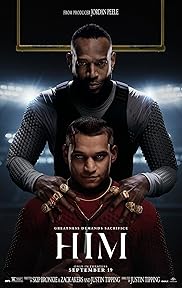 A young Black athlete gets the chance
to become the protege of Mario Van Peebles (
S.O.L.O.
), the greatest Quarterback in the world.
The training takes place at Mario's ranch in the desert.
Lots of strange things happen.
A young Black athlete gets the chance
to become the protege of Mario Van Peebles (
S.O.L.O.
), the greatest Quarterback in the world.
The training takes place at Mario's ranch in the desert.
Lots of strange things happen.
The movie appears to be an extended metaphor about how the US sports industry works. Young Black men endanger themselves for the benefit of rich old White men.
This was produced by Jordan Peele . Presumably the writer/director is his protege, because it certainly has his touch.
 A yuppie (Michael Early -
Almost Human
) and his wife buy a house from an old man named Charlie (Denis Quaid -
Inner Space
). While the husband has after-work drinks with his cow-orker (
Erica Serra
), the wife is kept company by Charlie.
However, the old man reveals a creepy side -
as if he can't let go of his old home,
and is trying to force them out of it.
A yuppie (Michael Early -
Almost Human
) and his wife buy a house from an old man named Charlie (Denis Quaid -
Inner Space
). While the husband has after-work drinks with his cow-orker (
Erica Serra
), the wife is kept company by Charlie.
However, the old man reveals a creepy side -
as if he can't let go of his old home,
and is trying to force them out of it.
The neighbour from hell trope was the basis of a thriller subgenre from the early Nineties. More recently, the trope of the old man who warns the kids about danger has been modified in haunted house movies that have made their ghost into a death omen. So which trope is at play here? Well, the old man's real motivation is actually nonsensical.
The climax predictably involves a young black woman being chased by an old white man who owns a red baseball cap. Obviously a statement about the Make America Great Again movement.
 Jacob Singer (Michael Ealy -
Almost Human
), a USMC veteran who served in Iraq,
is now a doctor working in an American hospital.
He is happily married to
Nicole Beharie
, the ex-lover of his dead brother.
Jacob Singer (Michael Ealy -
Almost Human
), a USMC veteran who served in Iraq,
is now a doctor working in an American hospital.
He is happily married to
Nicole Beharie
, the ex-lover of his dead brother.
This is a remake of the classic 1990s supernatural thriller. There are a few updates, which actually make the film better (if more pedestrian) by removing a plot hole or two.
 Sue-Ann (
Octavia Spencer
) is a middle-aged woman who gets bossed around by her bossy boss (
Alison Janney
). If the role had been cast for a white male,
he would be disregarded because of his Incel status.
But casting Spencer in the role is inspired.
Sue-Ann (
Octavia Spencer
) is a middle-aged woman who gets bossed around by her bossy boss (
Alison Janney
). If the role had been cast for a white male,
he would be disregarded because of his Incel status.
But casting Spencer in the role is inspired.
This film marks Spencer as the black Kathy Bates. She starts out opening her own whistletop cafe, serving beer to underage kids rather than friend green tomatoes, but ends up more like the Bates character in Misery .
Sue-Ann had a hard time at High School, and ended up in a Carrie type situation. Now her classmates have grown up - Erica ( Juliette Lewis ), Ben (Luke Evans - Dracula Untold ) and Mercedes ( Missi Pyle ). Sue-Ann seems to be hanging out with the kids in order to live out a fantasy of an idealised High School life, but she turns out to have a more sadistic and violent plan to set right her teenage regrets.
As well as the impressive casting decisions, the movie also has some shot composition that borders on the Spielbergian.
 Xavier Carr (Jermaine Fowler -
) is a Black police officer in the LAPD.
His younger brother is a gang member in the LA Crips.
Their mother is a self-identified zulu witch-doctor or whatever.
This all turns out to be important later.
Xavier Carr (Jermaine Fowler -
) is a Black police officer in the LAPD.
His younger brother is a gang member in the LA Crips.
Their mother is a self-identified zulu witch-doctor or whatever.
This all turns out to be important later.
Xavier's partner, Ethan Hawkins (Justin Long - Barbarian ), is applying to join an elite unit called the Night Patrol. His father, the Sarge (Dermot Mulroney - ), was a member ... before he died in mysterious circumstances. Ethan wants to find out the truth about Night Squad. To do this he must do very bad things, although he thinks of himself as one of the good ones.
One of the Black street-gang members is a conspiracy theorist, constantly telling everyone that the world is run by a secret cabal of lizard people. Of course, this is based on the TV series V (1983) . The much older archetypical monster that represents the oppressive aristocratic elite is the Vampire. Dracula is a Count for a reason.
Basically the Black community is being oppressed by White cops. Worse, these bloodthirsty cops see the Black people as being racially inferior, the equivalent of farmyard animals. This is a bit heavy-handed, but the vampire metaphor works well. That said, the old Rage of the Black man routine is really wearing a bit thin these days.
 Keith David (
The Thing
) runs the only Black-owned horse stables in the Hollywood industry.
One day the ranch has a bout of strange weather,
and the old man is injured by Foreign Object Damage
as things start falling from the sky.
This leaves his son, Daniel Kaluuya (
), in charge of the business.
Of course, the strange weather comes back ...
Keith David (
The Thing
) runs the only Black-owned horse stables in the Hollywood industry.
One day the ranch has a bout of strange weather,
and the old man is injured by Foreign Object Damage
as things start falling from the sky.
This leaves his son, Daniel Kaluuya (
), in charge of the business.
Of course, the strange weather comes back ...
Daniel's sister ( Keke Palmer ) pops up to help out with the business. She even helps assemble a team to investigate the weather. Well, she hires a tech support guy and an old-school film director (Michael Wincott - The Crow ). However, her presence makes the film feel unbalanced. While the first Act of the film is about Kaluuya, the final Act centres on Palmer as the Final Girl.
The core of the film is about Jupe (Stephen Yeun - The Walking Dead ), who runs a theme park at the bottom of the ranch's valley. A former child star, Jupe is haunted by the events of a disasterous episode of his 1990s TV show when a chimpanzee attacked his co-stars. Now he seeks to make it right, by taming a dangerous predator and incorporating it into his live show.
This was written and directed by Jordan Peele . The nearest comparison would be with Beast (2022) , which is a much more straightforward film. Peele's movie is a lot more original and creative.
 Vanessa (
Danielle Deadwyler
) vacations with her husband (Aldis Hodge -
Black Adam
) and his brother Martel (Edwin Hodge -
The Tomorrow War
) in a
Cabin in the Woods
. She is struggling mentally since the death of her son a year ago.
Vanessa (
Danielle Deadwyler
) vacations with her husband (Aldis Hodge -
Black Adam
) and his brother Martel (Edwin Hodge -
The Tomorrow War
) in a
Cabin in the Woods
. She is struggling mentally since the death of her son a year ago.
Vanessa goes for a walk in the woods. However, she discovers that the area is a nexus for the multiverse. Not only does she have to find her way home, avoiding alternate timelines which have varying levels of hostility, but she also has to avoid another version of herself who has decided to shoot her on sight.
Apparently Aldis and Edwin are real-life brothers who write the script together, based on a Chinese movie named Parallel Forest AKA Ping Xing Sen Lin.
 The movie is set in Dixieland, USA, in 1932.
It starts with Sammie Moore,
a young African-American Blues musician,
who survived a murderous attack the night before.
Of course, the main story starts 24 hours previously.
The movie is set in Dixieland, USA, in 1932.
It starts with Sammie Moore,
a young African-American Blues musician,
who survived a murderous attack the night before.
Of course, the main story starts 24 hours previously.
Smoke and Stack (Michael B. Jordan - Black Panther ), a twin pair of gunslingers, return to their home-town and buy a disused saw-mill. It seems that the manufacturing industry is being replaced by the service sector. Along with their girlfriend Mary ( Hailee Steinfeld ) and their old friend Delta Slim (Delroy Lindo - ), they start a Juke Joint.
On the nightclub's opening night, the party is gatecrashed by Remmick (Jack O'Connell - 28 Years Later ). He is a fellow musician, but because he is Irish-American he is banned from the segregation-era Blacks-only club. Just as well, because he is a vampire. Before long he is turning local people, and building a small army of followers to besiege the club.
This take on the vampire myth has some familiar touches, but puts its own spin on things. The vamps are vulnerable to sunlight, a trope first used in Nosferatu (1922) . They are a hive-mind, copying whatever the Master-Vamp Remmick wants them to do. This means they can play perfectly coordinated music, for example. Also, they share memories. However, if the Master-Vamp dies the others will not.
This was written and directed by Ryan Coogler . While From Dusk til Dawn was about transgressive protagonists who trespass in a vampire-controlled venue, Coogler's film is about reactionary heroes who want to preserve their status quo. Of course, Coogler shoe-horns in an unnecessary subplot featuring the Klu Klux Klan, but this does not change the nature of the main storyline.
 Oakland, California.
Cassius Green (Lakeith Stanfield -
Girl In The Spider's Web
) gets a job as a telemarketer.
An old-timer named Langston (Danny Glover -
Proud Mary (2018)
) gives him special advice - use your white voice.
This allows him to cross social class boundaries,
which is the key to his success.
Oakland, California.
Cassius Green (Lakeith Stanfield -
Girl In The Spider's Web
) gets a job as a telemarketer.
An old-timer named Langston (Danny Glover -
Proud Mary (2018)
) gives him special advice - use your white voice.
This allows him to cross social class boundaries,
which is the key to his success.
Cassius discovers his girlfriend Detroit ( Tessa Thompson ) is involved in political activism, and his new friend Squeeze (Stephen Yeun - The Walking Dead ) tries to organise a Trade Union for the workforce. Not much subtlety here.
The climax involves Corporate CEO Steve Lift (Armie Hammer - Lone Ranger (2014) ). The plan of the capitalist to exploit the labouring class is finally laid bare. In keeping with the rest of the film, this is exaggerated out of all proportion. Instead of merely treating humans as beasts of burden, he will literally transform them into beasts. More like Dr Jekyll than Dr Moreau.
 A deaf young girl is in a domestic violence household,
and ends up in an orphanage.
Years later, as a young woman, she becomes a music student at college.
Her hearing has returned, but will probably deteriorate again around the age of thirty.
The good news is that she discovers a way to stimulate her hearing.
The bad news is that she can only be stimulated by sounds of pain and violence.
A deaf young girl is in a domestic violence household,
and ends up in an orphanage.
Years later, as a young woman, she becomes a music student at college.
Her hearing has returned, but will probably deteriorate again around the age of thirty.
The good news is that she discovers a way to stimulate her hearing.
The bad news is that she can only be stimulated by sounds of pain and violence.
Why is this listed among Blaxploitation horror movies if the only black person in the main cast is the main character? Well, the biggest name in the cast list - in fact, the only recognisable one - is the actress playing the blonde room-mate, Lilli Simmons . Normally the blonde girl would play the lead role, using the biggest name in order to maximize the film's marketability. The obvious deduction is that casting the black girl as the lead is also a deliberate cash-in on the blaxploitation horror subgenre.
 A rich African-American lawyer earns lots of money helping Mega-Corporations to defeat class-action lawsuits.
This is portrayed as betraying Black America to help White America,
a typical oversimplification from this genre.
A rich African-American lawyer earns lots of money helping Mega-Corporations to defeat class-action lawsuits.
This is portrayed as betraying Black America to help White America,
a typical oversimplification from this genre.
The protagonist flies his wife and teenagers to meet his family. The plane crashes, and the protagonist wakes up in a sick-bed. It turns out that he is in a Misery situation.
There is an element of justification in the villains' role. After all, the protagonist has done exactly what they accuse him of - abandoning his roots and his community to satisfy his own avarice.
In line with Blaxploitation Horror, and opposed to the normal Fem-Jep, the protagonist becomes pro-active and goes kill-crazy. This is what Jordan Peele characterised as the Rage of the Black Man, perhaps a reference to the character of Mouse in Walter Mosley's Easy Rawlins stories.
 Kiersey Clemons
is washed ashore on a desert island in the Pacific ocean.
This was filmed on Fiji, so at least the setting is authentic.
Kiersey Clemons
is washed ashore on a desert island in the Pacific ocean.
This was filmed on Fiji, so at least the setting is authentic.
At first, our heroine settles into life alone on the deserted desert island. With the only other person washed up a corpse, this is a lot like Tom Hanks in Castaway. However, she eventually realises she is not really alone. There is a monster on the loose.
At first, the creature is quite intimidating. After all, it is barely shown on-screen at first - merely hinted at in silhouette and sounds. Later we get to see a lot more of it, both in rubber suit form and in CGI form. It is basically a merman, perhaps inspired by the one in Cabin in the Woods . Although aquatic in nature, for some reason it lumbers slowly onto dry land so it can eat whatever fish the protagonist caught. Yes, this is despite the fact it can easily catch enough fish by itself.
A few days later, a life-raft appears. The protagonist is joined by her boyfriend (Benedict Samuel - Pimped ) and their buddy, Hannah Mangan Lawrence . Unfortunately the boyfriend and buddy seem to have bonded during their days on the raft, which leaves the protagonist as the odd-one-out. Finally we get some real tension, derived from a realistic threat rather than a rubbery CGI one.
 Anthony Mackie (
Captain America: Winter Soldier
) is a paramedic in New Orleans.
He and his partner, Jamie Dornan (
Robin Hood (2018)
), deal with a sudden increase in strange deaths.
The one thing the victims all have in common
is that they used a designer drug named Synchronic.
Anthony Mackie (
Captain America: Winter Soldier
) is a paramedic in New Orleans.
He and his partner, Jamie Dornan (
Robin Hood (2018)
), deal with a sudden increase in strange deaths.
The one thing the victims all have in common
is that they used a designer drug named Synchronic.
When a young woman disappears without trace after using the drug, Mackie investigates it personally. It turns out that the drug affects the pineal gland, and pushes the user to an almost random point in history. Mackie experiments with the time travel in the hope of saving the girl.
Mackie's experiences in previous time periods in the USA are sharply contrasted with those of the middle-class white people in Back To The Future . The audience is left with no doubt that a Black man would not have been so happy to land in Fifties America.
 This is about a young African-American boy
who lives in a poor neighbourhood in Los Angeles.
What makes him unusual is that he is obsessed with vampires.
He even thinks he has become one.
This is about a young African-American boy
who lives in a poor neighbourhood in Los Angeles.
What makes him unusual is that he is obsessed with vampires.
He even thinks he has become one.
There are many name-checks of vampire movies, both famous and obscure. One that stands out is Martin , because that film seems to be the template for this one.
The vampire's victim's include Lloyd Kaufman , head of Troma Studios, who has a cameo as an old homeless man.
 A young woman (
Lupita Nyongo
) and her friend (
Elizabeth Moss
) spend the summer hanging out with their families.
That night, Lupita's family are attacked by four strangers
who are their exact doppelgangers.
A young woman (
Lupita Nyongo
) and her friend (
Elizabeth Moss
) spend the summer hanging out with their families.
That night, Lupita's family are attacked by four strangers
who are their exact doppelgangers.
Writer/director Jordan Peele is best known for his previous movie Get Out! , and this has certain similarities. Normally a stalk-and-slash movie has reactive protagonists who run away from danger rather than fight, but Peele's heroes tend to use brutal violence at the first opportunity. He justifies that with the rage of the black man mantra that is epitomised by the character of Mouse in the crime thriller Devil in a Blue Dress . However, in this genre it seems out of place to the extend that it just makes them look insanely violent.
 Chris Rock narrates a tale set in 1968,
which explains the outmoded technology.
When his parents died in a car crash,
he went to live with his grandmother (
Octavia Spencer
) in Chicago. She was a wise old healer,
who saved him when a real-life witch came into their neighbourhood.
Chris Rock narrates a tale set in 1968,
which explains the outmoded technology.
When his parents died in a car crash,
he went to live with his grandmother (
Octavia Spencer
) in Chicago. She was a wise old healer,
who saved him when a real-life witch came into their neighbourhood.
In order to escape from the witch, Grandma takes her little ward to her favourite hotel in Alabama. The manager (Stanley Tucci - Hunger Games ) is a horrendous snob, typical of the kind of character that Tucci normally plays. It seems he is intended to be a villainous figure of White Power, like the Sheldon Cooper character in Hidden Figures .
The hotel is hosting the annual conference for a group purporting to be dedicated for the prevention of cruelty to children. Unfortunately, it turns out to be a convention of the very witches that Grandma and Junior are trying to escape from. What a coincidence!
The leader of the Witches ( Anne Hathaway ) has decided to announce her masterplan to kill all children in the world. Of course, this would lead to the extinction of the human species - but the story was written for kids so it does not have to make sense any more than the average YA novel.
 Ramona (
Danielle Deadwyler
) lives in a remote farmhouse with her two children.
She is crippled - temporarily by a car crash which broke her leg,
and emotionally by the loss of her husband David (Russell Hornsby -
Grimm
) in the same car crash.
Ramona (
Danielle Deadwyler
) lives in a remote farmhouse with her two children.
She is crippled - temporarily by a car crash which broke her leg,
and emotionally by the loss of her husband David (Russell Hornsby -
Grimm
) in the same car crash.
The family discover a black-veiled woman sitting in their front yard. She is a spectral being that haunts them. It seems that she is the embodiment of grief, like The Babadook . However, the truth is much worse.
Jason Blum delivers yet another low-budget Blumhouse effort. Set in one location with a cast of five, this is incredibly compact.
 Donna D'Ericco
is the great-grandaughter of the Candyman.
She faints every time she sees him, which is probably for the best.
Donna D'Ericco
is the great-grandaughter of the Candyman.
She faints every time she sees him, which is probably for the best.
Donna sells her great-grandaddy's paintings to a Latino Art dealer. He has a big showing of them at his gallery in a Spanish-speaking part of Los Angeles. This is a great opportunity for us to meet the bunch of cliched stereotypes that Candyman will spend the rest of the movie slashing his way through.
 This is set as a soft reboot rather than a hard one,
since it is set in the aftermath of the first film.
The story of Ellen (
Virginia Madsen
) has become an urban myth in its own right,
with the Black community co-opting the Police story of her in the villain role.
This is set as a soft reboot rather than a hard one,
since it is set in the aftermath of the first film.
The story of Ellen (
Virginia Madsen
) has become an urban myth in its own right,
with the Black community co-opting the Police story of her in the villain role.
The new protagonist is an artist (Yahya Abdul-Mateen II - Watchmen (2019) ) who hears the story, and visits Cabrini Green. The place is getting gentrified, but local man William Burke (Colman Domingo - Fear the Walking Dead ) has been around long enough to know the original Candyman stories. It turns out that each generation has their own Candyman, an innocent Black man killed off by White oppressors. However, this seems to be a self-fulfilling prophecy. The Black community are indoctrinated with the idea that they will always be oppressed, and when they accept this apparent inevitability they have to embrace the Cult of the Candyman. By definition, this ignores the success of the Black middle class.
The invisible Candyman, only visible in the mirror, adds a new level of terror to the concept. However, fans will be pleased to hear that Tony Todd actually gets a cameo.
Director Nia DaCosta is female, and writer Jordan Peele is male, so at least gender diversity is catered for. However, the storytellers and main characters are all Black and the result is clearly intended only for a Black audience. Black characters point out that the mass media only cares about the Cabrini Green murders because a White woman was killed ... but the vast majority of victims in this movie are White-passing and female.
There is also the issue of Cultural Appropriation. This is a Blaxploitation version of a story originally written by a White man from England.
 The protagonist (
) spends a one-night stand with a beautiful woman (
Hilary Swank
). Unfortunately, he has a wife and a troubled marriage.
The protagonist (
) spends a one-night stand with a beautiful woman (
Hilary Swank
). Unfortunately, he has a wife and a troubled marriage.
Back home, someone tries to kill the protagonist. Worse, the investigating detective is ... the mysterious woman he had the one-night stand with.
The detective had an unhappy marriage of her own. Now divorced, her ex-husband ( ) is preventing her from having access to her child. This gives her ample motive to kill him. Of course, she is too smart to do it herself. Instead she uses the old Strangers on a Train criss-cross plan, exchanging one killing for another. This is also the basis for a couple of Female Killer movies, so it is becoming almost a cliche these days.
As with all Film Noir movies, a crime is committed and the protagonist is implicated.


